
How to Set Your Dental Clinic Price List in the Philippines (2026 Benchmarks)
NgipenHub Team · NgipenHub Editorial Team
September 21, 2026
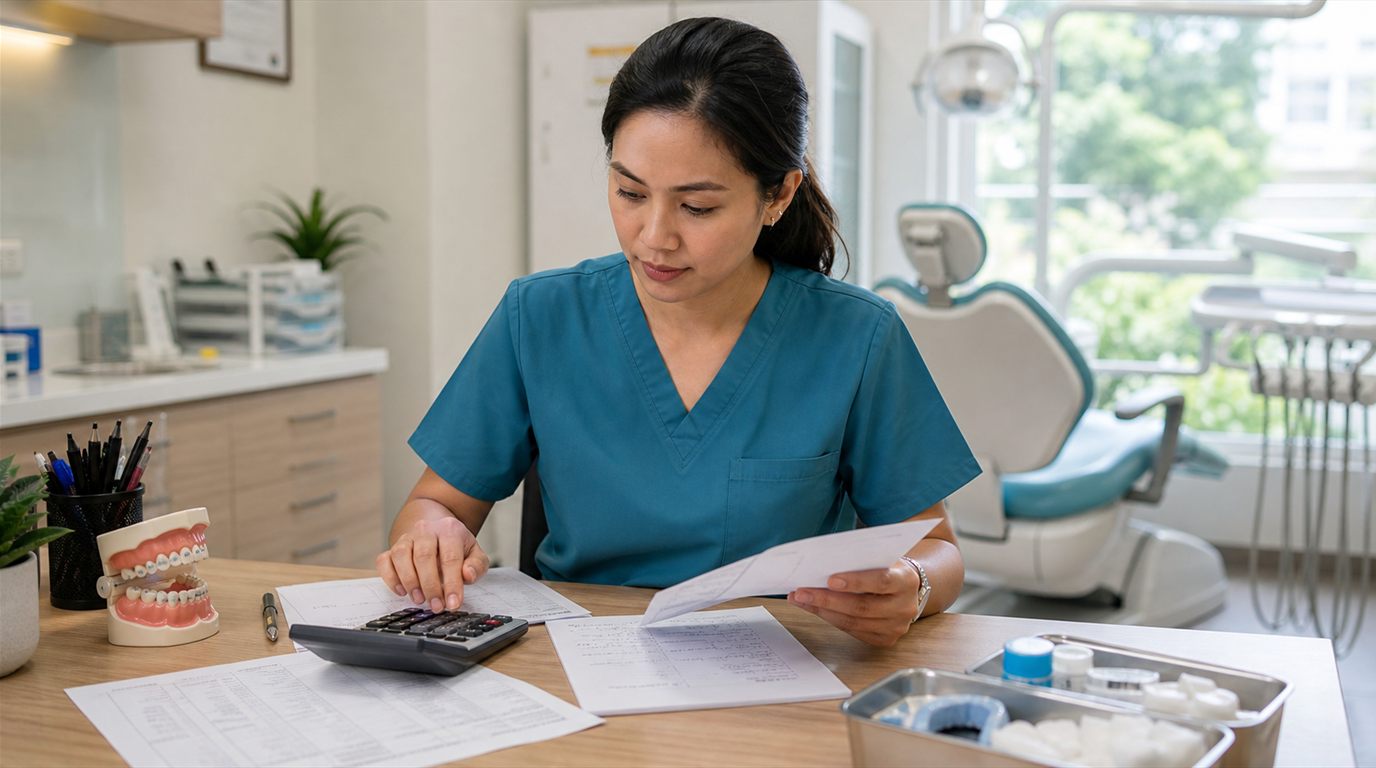
Pricing is the most consequential decision a Philippine dental clinic makes and usually the least examined. Most owners set their rates by asking a friend what they charge, then adjust only when a patient complains. That produces price lists that are simultaneously too low on the routine work that fills the schedule and too vague on the complex work that pays the bills.
This guide gives 2026 market benchmarks drawn from our own price research across Philippine clinics, then a method for setting your own list.
2026 market benchmarks
These ranges reflect private clinic pricing across the Philippines. The low end generally corresponds to provincial and neighbourhood clinics; the high end to premium Metro Manila practices in BGC, Makati and Ortigas. Government hospital dental centres and dental school clinics sit below the low end.
| Service | Typical private clinic range (2026) |
|---|---|
| Consultation / initial visit | ₱300 – ₱700 |
| Oral prophylaxis (routine cleaning) | ₱800 – ₱1,500 |
| Cleaning, standard urban clinic | ₱1,500 – ₱3,000 |
| Deep cleaning (heavy tartar, gum disease) | ₱3,000+ |
| Composite filling (per tooth) | ₱1,000 – ₱3,000 |
| Composite filling (per surface, premium) | ₱2,000 – ₱4,500 |
| Simple extraction | ₱500 – ₱3,000 |
| Surgical extraction | ₱3,000 – ₱10,000 |
| Impacted wisdom tooth | ₱5,000 – ₱20,000+ |
| Root canal, anterior | ₱6,000 – ₱15,000 |
| Root canal, molar | ₱10,000 – ₱30,000+ |
| Complete denture (per arch) | ₱10,000 – ₱30,000 |
| Partial denture | ₱5,000 – ₱12,000 |
| In-clinic teeth whitening | ₱9,000 – ₱20,000 |
| Metal braces (full treatment) | ₱30,000 – ₱80,000 |
| Ceramic braces | ₱50,000 – ₱100,000+ |
| Clear aligners | ₱80,000 – ₱170,000+ |
| Panoramic X-ray | ₱500 – ₱1,500 |
Use these as orientation, not as a rate card to copy. A clinic that prices identically to the market average has told patients nothing about why they should choose it.
Build your list from cost, not from the competition
Copying a neighbour's prices imports their cost structure, which you cannot see. Work from your own numbers instead.
Work out your chair-hour cost
Add your fixed monthly costs — rent, utilities, salaries, equipment amortisation, licences, insurance — and divide by the number of productive chair-hours you realistically deliver in a month. Note the word realistically: a chair is not productive for every hour the clinic is open. This gives you the floor beneath which a procedure loses money regardless of what anyone else charges.
Add materials per procedure
Composite, burs, anaesthetic, impression material, lab fees. Lab-heavy work such as dentures and crowns is where under-costing does the most damage, because the lab invoice arrives whether or not you priced for it.
Price the time honestly
A procedure that takes ninety minutes and one that takes twenty cannot carry the same margin logic. Clinics routinely underprice long appointments because the fee "sounds" high, forgetting it occupies a chair that could have seen three other patients.
Where clinics most often get it wrong
- Underpricing cleanings. Prophylaxis is the most common appointment in most Philippine clinics. Pricing it below cost to attract patients means the busiest part of your schedule subsidises everything else.
- One flat price for fillings. A single-surface filling and a deep multi-surface restoration are different procedures. Charging one price means simple cases overpay and complex ones lose money.
- Forgetting lab costs on dentures and crowns. The most common source of negative-margin work.
- Ignoring the HMO gap. If you are HMO-accredited, the covered rate is usually well below your cash rate. That is workable as a patient-acquisition trade, but only if you know the size of the gap. Our guide on HMO accreditation for dental clinics covers this.
- Competing on price alone. There is always a clinic willing to go lower. Availability, cleanliness, Saturday hours and a dentist who explains things are all things patients pay more for.
Publish the ranges
Once your list is set, publish it — as ranges, with a short note on what moves the price. Cost is the number one hesitation among Filipino dental patients, and the clinic that answers it before the phone call wins the appointment.
Ranges protect you from being held to a figure when a case turns out to be more complex, while still answering the question. "Composite filling ₱1,500–₱3,000 depending on cavity size and number of surfaces" is honest, useful, and does not commit you to anything.
You can publish your services and prices on your free NgipenHub clinic listing, where patients filter by service and city.
Review it once a year
Material costs, lab fees, rent and salaries all move. A price list left untouched for three years is quietly shrinking. Put a yearly review in the calendar, and raise prices in small increments rather than in one jarring correction.
Frequently Asked Questions
How much should a dental cleaning cost in the Philippines?
Routine oral prophylaxis at private Philippine clinics generally runs ₱800–₱1,500, with standard urban clinics charging ₱1,500–₱3,000 and deep cleaning for heavy tartar or gum disease going above ₱3,000. Government hospital dental centres and dental school clinics charge considerably less.
Should a new dental clinic price below the market to attract patients?
It is a difficult position to climb out of. Patients attracted purely by price tend to move on when someone cheaper opens, and raising rates later reads as a betrayal to the people who came for the discount. Competing on availability, Saturday hours, clear explanations and a clean, modern clinic builds a patient base that stays.
Do Philippine dental clinics have to publish their prices?
There is no requirement to publish a rate card. But cost is the biggest single hesitation Filipino patients report, and a clinic that answers it publicly captures patients who would otherwise keep searching. Publishing ranges is a commercial decision, not a regulatory one.
How often should a dental clinic update its price list?
At least once a year. Materials, lab fees, rent and salaries all drift upward, and a list left unchanged for several years steadily erodes margin. Small annual adjustments are absorbed far better by patients than a single large correction.
List Your Dental Clinic on NgipenHub
Free listing, no credit card, no contract. Add your services, photos, and hours, and start appearing in front of patients searching for clinics in your city.
List My Clinic Free